A Suburban Backyard Problem
There’s a familiar problem with suburban backyards that many people rarely mention, yet you may have noticed it yourself. You walk into your garden, and even after adding plenty of greenery, mulch, and thoughtfully designed elements, it may still seem cramped and closed in. The fence can appear to form a solid visual boundary, while the most attractive views and scenery seem to sit just past it.
It’s Called Shakkei
And it’s almost entirely absent from how the West designs private outdoor space. It’s called shakkei. Once you understand how this technique works, you may never view your own yard—or even your neighbor’s trees—in quite the same way again.
Translates as borrowed scenery. Two characters, shaku, to borrow, and kei, view or landscape.
Extending Beyond the Garden Boundary
The principle is simple: an exceptional garden doesn’t have to end where its property line begins.
It reaches out visually and takes something from beyond the property.A faraway mountain, a mature tree in a neighboring yard, the roofline of a distant temple, or even a drifting cloud can become part of the garden’s visual design, making the surrounding landscape feel naturally connected to the space.
Bringing Borrowed Scenery Into the Garden
Now, some people in the Japanese garden design world disregard shakkei and believe from a purist standpoint that you shouldn’t rely on the outside and you should be focused on only what’s within the boundaries of your Japanese garden. For this discussion, I’m leaning towards embracing borrowed scenery. The distant element becomes the garden’s final feature without it owning it.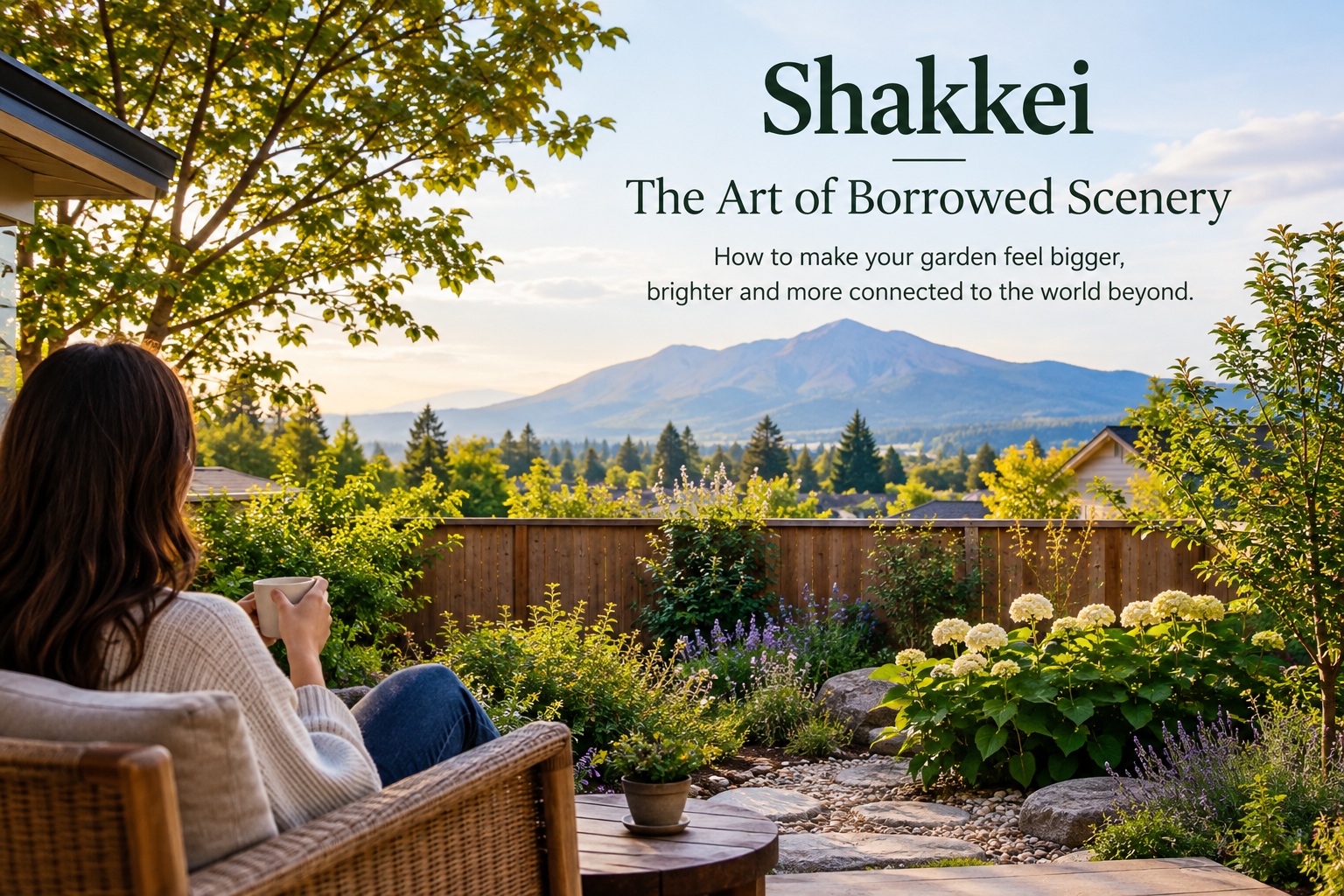
Captured Alive
But here’s the detail I love because I think it really changes things. The original Japanese term for this technique wasn’t shakkei, it was ikedori, which literally means captured alive. The garden doesn’t just borrow the mountain. It captures it the way you might catch a wild bird without harming it.
An Act of Composition
With such deliberate framing, such careful design of your own space that the distant thing quietly becomes yours. Alive, unowned, and yet somehow held. I think about that word a lot because it means something the English translation misses. Shakkei isn’t a passive borrowing. It’s an act of composition.
As Though the World Ends at the Fence
You’re not putting a mountain in your garden. You’re building the garden so precisely that the mountain has no choice but to join in. Once you understand that, you realize why the average American backyard feels so small. It isn’t small. It’s just been designed as though the world ends at the fence.
Shakkei Done at Four Different Scales
Let me show you shakkei done at four different scales because seeing the range is what makes it click. Enkoji in the northern hills of Kyoto is the one most people think of first, and it might be the purest example of shakkei ever built. Sit on a wooden veranda looking over a small, austere garden.
The Garden’s Dramatic Final Gesture
A few placed stones, a low clipped hedge of azaleas. That’s the entire garden proper. But your eye doesn’t stop at the hedge. It’s pulled across a valley to Mount Hiei in the distance. And in that moment, the mountain becomes the garden’s dramatic final gesture.
Instead a Frame
The hedge, which could have been a wall, is instead a frame. Careful horizontal line that presents the mountain like an offering. 1,500 years of horticulture and the most powerful element in the composition is something the gardener didn’t plant.
One Continuous Landscape
Tenryuji in Arashiyama, one of the earliest gardens to use the technique. Many researchers consider it to be the original example. The garden uses Arashiyama’s tree-covered hills as a natural backdrop, visually connecting the pond in the foreground with the mountains in the distance to create a seamless, continuous landscape.
A Single Composition
You’re seeing isn’t really the temple garden. It’s the temple garden plus the hills working together as a single composition. The property line has become invisible.
Shakkei on a Grand, Epic Scale
Shugakuin Imperial Villa, also in Kyoto, is shakkei on a grand, epic scale. You climb through a series of smaller gardens up a hillside. And when you finally reach the top tea house, you get one of the most staggering borrowed views in all of Japan, a vast pond below, rice paddies and forest stretching outward, and the western mountains of Kyoto rolling into the distance.
The Modern Masterclass
Emperors used to sit there. It was designed to inspire awe, not by size of ownership, but by mastery of integration. And then there’s the Adachi Museum of Art in Shimane, which is the modern masterclass in this. 19 straight years, it’s been ranked the most beautiful garden in Japan. And it wasn’t built until 1970.
Designed to Be Viewed, Not Walked
Its designer, Kinsaku Nakane, worked backwards from a single question. What if the garden were designed to be viewed, not walked? Nothing is composed to be seen through enormous glass windows inside the museum. Each window framing the garden and the distant mountains as one living painting.
Protect the View
Some cases the museum has even purchased land far beyond the garden. Not to build on it, but to protect the view. That’s how serious they take shakkei. The borrowed landscape is treated as part of the collection.
Four Gardens, Four Scales
Four gardens, four scales, from a single hedge in a mountain to an imperial hillside to a modern museum designed as a viewing chamber. And the principle is the same across all of them. Design your own space so precisely that the world beyond it has to join the composition.
The Necessary Mental Flip
Let me tell you what happens when you take that same principle back to an ordinary suburban yard. So, here’s the necessary mental flip. Most western yard design starts with a question. What should I put inside my property line? You look at the empty space and you think about filling it.
Look Outward First
You plant trees, install a patio, add flower beds, put in a fire pit. All the design attention flows inward. Shakkei starts with the opposite question. What already exists beyond my property that I can pull in? You stand in your yard and look outward first.
That Is Your Mount Hiei
What is your yard already surrounded by that you’ve been ignoring? A mature oak in your neighbor’s yard? A distant church steeple? A rise of ground two streets over? Even a well-shaped street tree. That is your Mount Hiei. That’s the thing you’re going to capture alive.
The First Move Is to Frame It
Once you’ve identified it, three things follow, and none of them are expensive. The first move is to frame it. Great shakkei gardens don’t just leave the borrowed view exposed. Pose an opening for it, a break in a hedge, a gap between two trees, a window, and a fence.
Like a Picture in a Frame
This could involve reducing part of a privacy fence so that a neighbor’s oak tree appears to form a natural canopy, or placing two upright evergreen trees on either side of the viewing line so the distant feature appears centered between them like a framed picture. The goal isn’t to reveal everything in the surrounding landscape.
You’re trying to see one right thing deliberately.
Hide Everything That Competes with It
The second move is to hide everything that competes with it. This is the part western designers usually skip, and it’s why so many suburban yards feel busy without feeling composed. If your borrowed element is a beautiful distant tree, you need to obscure the ugly shed on the left of it, the utility pole to the right, and the second-story window of the neighbor across the way.
Without Competition
Not necessarily with a fence, with layered plantings, bamboo screens or tall grasses, evergreens and hedges. The Japanese gardener is more likely to ask, “What should I hide?” So that the one right thing shows without competition.
A Place to View From
The third move, and this is the one that changes the feel of the whole yard, is to build a place to view from. Shakkei only works if there’s a specific spot the composition is designed to be seen from. At Enkoji, it’s the veranda. At Adachi Museum, it’s a window.
Designed in Relation to It
In your yard, it might be a bench, a small patio, a step at the back door, a specific chair. Once that viewing spot exists, everything else in the garden gets designed in relation to it and the borrowed element out beyond your fence gets aimed at your eye from that seat.
Your Yard Doubles in Perceived Size
Do those three things and something quietly extraordinary happens. Your yard doubles in perceived size. Not because you added anything, but because you stopped pretending the world ended at your property line. The dominant western instinct in a small backyard is to enclose and fill.
Smaller the More You Add to It
Build a taller fence for privacy. Cram the interior with features. Treat the property as a room to be furnished. It comes from good instincts, protection, ownership, use, but the result is often a space that feels smaller the more you add to it. Because every new thing inside the fence emphasizes the fence.
Your Yard Isn’t a Room, It’s a View
Shakkei quietly refuses that whole logic. It says your yard isn’t a room, it’s a view. And the most important elements of a view are almost never inside the frame of a picture. They’re the things that give the picture depth.
Not a Fortress Wall
A shakkei garden views its property boundary as the frame of a larger landscape rather than a solid barrier that cuts the garden off from its surroundings.
And it treats the world beyond as raw material. This isn’t just a Japanese idea either. Every landscape painter who’s ever composed a scene understands it.
The Missing Move
You don’t paint what’s in front of you. You paint the relationship between the foreground, the middle ground distance, and the far horizon. Shakkei is that principle applied to real ground you can walk on. And it’s the missing move in almost every American backyard I’ve ever seen.
An Attitude Toward Boundaries
I have a background in landscape design and I have to tell you that shakkei was the single principle I understood latest and the one that changed my thinking most because it isn’t really a garden technique. It’s an attitude toward boundaries. It says the line between what’s yours and what isn’t matters much less than how you compose across it.
The Shakkei Question
I think that in almost every photograph I make now when I frame a shot, some part of my brain is always asking the shakkei question. What beyond this scene can I pull into the composition? I’m searching for the depth. A branch reaching in from the left, a distant hedge right behind the subject.
Quietly Captured Alive
Light spilling from a room I’m not photographing. The picture always feels deeper when something outside the frame has been quietly captured alive. And I think it’s why so many contemporary American yards and honestly a lot of contemporary American lives feel a little bit boxed in.
Already Yours
We’ve been trained to think that what matters is inside our own perimeter. Shakkei is a very old, very generous connection. It says the mountain in the distance is already yours if you know how to look. The neighbor’s magnificent tree is already yours if you frame the view.
The Rest of the World Quietly Walks In
The world beyond your fence isn’t a problem to be blocked out. It’s the source of most of the beauty you’ll ever compose. Design your small space precisely enough, and the rest of the world quietly walks in.
Across All Four Seasons
If shakkei changed how you see your own yard, there’s a book I wrote you might love. Seasonal Japanese Garden Design. It takes this same way of thinking and applies it across all four seasons. So that your garden doesn’t just compose across space, but across time.
A Signature Style
Spring’s shinryoku, new green. Summer’s cooling strategies. Autumn’s momiji fire. Winter’s elegant restraint. It’s the fullest version of the design philosophy I can put on paper. Written for gardeners, landscape designers, and homeowners who want a signature style rather than a template.
A Slow Little Community
The link is down in the description. If you want to keep going with these ideas, I put together a guide to Japanese minimalism that pairs beautifully with garden design. And there’s a slow little community I run called Shien Circle for people drawn to this way of seeing.
Look Past the Fence FirstEach heading is taken directly from a phrase within its corresponding paragraph, with the first letter of every word capitalized. No additional words were added, and the original paragraphs remain unchanged.
Wherever you take these ideas next, I hope the next time you walk into your yard, you look past the fence first. There’s a whole composition out there waiting to be captured. Thanks for being here.