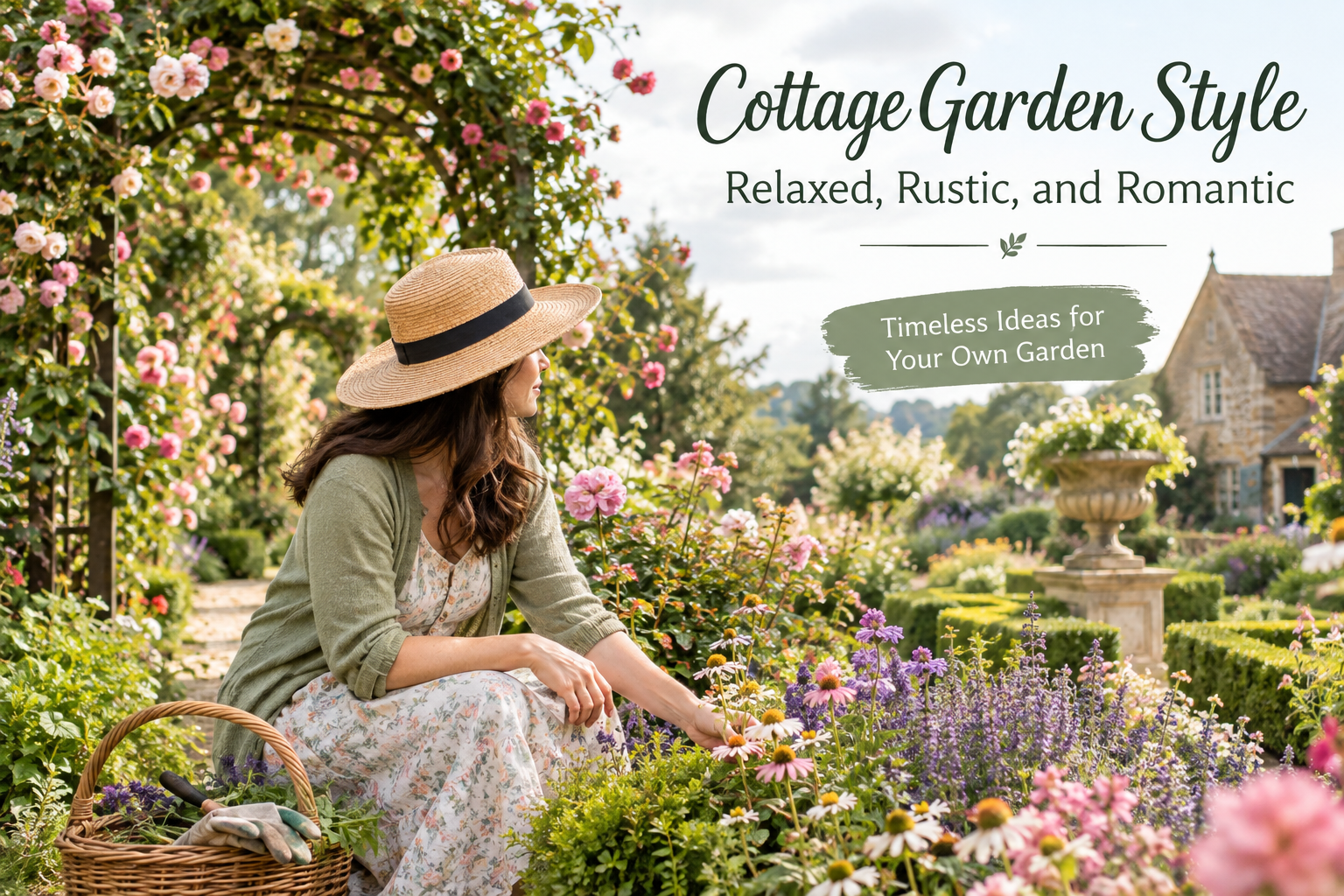
Cottage Garden Style: Relaxed, Rustic, and Romantic
Informal
Rustic
Naturalistic
Wild
Country-style
Romantic
Free-form
## Alexandra From The Middle-Sized Garden Shares Her Secrets
It’s Alexandra here from the Middle-Sized Garden YouTube channel and blog, and at the Middle-Sized Garden I have interviewed garden experts, head gardeners, and garden owners of some of the most beautiful English country gardens, both in England and around the world, and so I’ve picked out some key elements that are in these gardens so that you can use them in your own garden.
## The Classic Herbaceous Borders: Key Rules for Planting
If you have a small garden, creating deep borders can be challenging. Instead of dividing the space into two narrow borders, consider creating one generous, deep border that makes the most of the available area. You may only need a simple pathway or a very narrow strip of lawn alongside it. Planting perennials in groups of 7, 9, 11, or 13 creates a stronger visual impact, helping the garden feel fuller, more balanced, and beautifully planted.
## Why Big Clumps of Flowers Need To Be Graded
The other thing is that these big clumps of flowers need to be graded. The classic English herbaceous border look is taller at the back, middle-sized in the middle, smaller at the front, and obviously, if they’re clumps of seven or nine plants, they have to be three deep.
## Repetition Is the Secret of an English Country Border
The other important thing about an English country border is repetition. You’ve got maybe this big clump of irises in early summer, and there’ll be another big clump of irises further along the border, or perhaps in another matching border, and those two great blasts of colour will give you your interest in early summer, and then, when the irises are over, something else, like dahlias, will come out instead.
## An English Garden Has Rooms — Even a Small One Can
The next thing that an English garden has, of course, is rooms, and that’s because they were traditionally large gardens, but even in smaller gardens – different zones, different gardens – you can have rooms. By rooms, I mean areas that have a different theme or a different kind of planting, and, for example, you might have a formal area close to the house and then a wilder area further away.
## Something Called The Parterre Brings Formal Structure
It’s important to join up these areas as well, discover later on in the video. In terms of the formal area close to the house, there is something called the parterre.
## A Parterre Is a Small, Formal Area With a Centre Piece
A parterre is a small, formal area which is marked out in geometric patterns by paths, lawn, clipped hedging, or borders. There’s often something at the centre of it, such as a pergola or an urn.
## Jenny Has a Parterre With an Urn — and So Do We
In “Inspiring Garden Ideas from Five Country Gardens” video, which I’ll put in the description below, Jenny has a parterre with an urn in the middle and clipped hedging around. In our house, our parterre has got a pergola in the centre, but we have had a sundial, and we have had planting.
## A Rose Arch or a Rose Walk Makes a Classic Statement
Classic English garden roses, well, a rose arch or a rose walk would be how to do it. English garden roses advice from Peter Beales’ rose garden – a classic English garden and indeed any sort of pergola or walk with a climbing plant up it, such as wisteria, like at Gravetye Manor.
## Head Rosarian Ian Limmer on Pruning Climbing Roses
When you prune long climbing roses on a structure, keep upper gaps open.
Let sunlight and fresh air reach the lower leaves and blooms.
This keeps the bottom roses healthy, strong, and full of flowers.
When you prune long climbing roses on a structure, keep upper gaps open.
Let sunlight and fresh air reach the lower leaves and blooms.
This keeps the bottom roses healthy, strong, and full of flowers.
## Always Plant a Rose on Either Side of an Arch
He also says that you need to plant a rose on either side of an arch, because, of course, a rose won’t grow up and then grow down again, and if you are planting a series of rose arches, he says it looks best and more inviting to have the same rose on either side at the beginning of the rose walk.
## Focal Points Give You a Reason To Look Down the Garden
Focal points is another big thing – that could be sundials, urns, statuary. It gives you a reason to look down the garden, not just to enjoy what you’re seeing, but to enjoy the contrast with the planting around it.
## In a Smaller Garden, the Key Is Not To Go Small
If you’re trying to do this in a smaller garden, the key is not to go small. Trimmed hedges
Sheared hedges
Pruned bushes
Cropped fences
Formal hedging
Living walls
Border greenery
## Clipped Hedges Give Structure During the Winter
Now, the thing about Trimmed shrubs
Manicured bushes
Sculpted greenery
Formal hedging
Pruned plants [1, 2, 3]
is that they give you structure during the winter and something to look at, and in the summer the clipped hedges are a lovely, peaceful, green contrast to the riot of colour.
## Choosing a Hedge: What You Really Need To Think About
Hedges specialist Morris Hankinson, of Hopes Grove Nurseries, says that the main things that you need to think about when you’re choosing a hedge is: if it’s in a shady position, you must choose a hedging plant that is fine in shade, and if your soil is damp, you must choose a hedging plant that’s happy in damp soil.
## Topiary Can Be Expensive — But It Doesn’t Have To Be
I’ve got a video, which I’ll put in the description below, which is about choosing which hedge is right for your garden. As for topiary, it can be very expensive, you can grow your own – we did, with our home oak trees and this lovely holly – or you can make a big investment, which we did with this topiary spiral.
## Simpler, Cheaper Topiary Cones and Balls Still Look Great
But you can also create a very good effect by buying simpler, cheaper topiary cones and balls and simply arranging them in groupings, like the Perrys did in their country garden.
## The Ruins, the Follies, the Stumperies That Make English Gardens Special
One of the things that really makes classic English garden style quirky – touches, stumperies, follies, collections – is the quirkiness, the ruins, the follies, the stumperies, the collections. These gardens are typically created by individuals or collaborative partnerships rather than professional garden designers. Many have evolved naturally over 30 or 40 years, while some have developed and matured over several centuries, reflecting generations of care, creativity, and gardening tradition.
The Enchanting Stumpery at Doddington Place Gardens
In this stumpery at Doddington Place Gardens, they’ve created tree roots to make sculptures, they’ve put it in a shaded place, they’ve used shaded woodland planting, and the whole thing is magical, and it’s also very wildlife-friendly, because decaying wood is a great habitat.
## Creating a Mini Stumpery in Your Own Garden
You could do the same in your own garden by creating a mini stumpery the way Posy Gentles did in her front garden, with just a few little stumps, and I’m trying to do one in my garden, but I can’t really find any very pretty stumps, so not every tree stump you dig up is pretty, but actually they’re all valuable to wildlife.
## Building Ruins Out of Salvaged Materials
As for ruins, you can make them yourself out of salvaged materials. Eric Cameron, at Great Comp, was picking loads and loads of flints out of the borders in order to make the soil better for planting, and so he decided to create ruins in the garden.
## Builders’ Yards and Salvage Yards Are Full of Possibilities
He bought seconds from builders’ yards and salvage yards, and he even created a little hill on his flat area of garden, which gave him an opportunity to create a bit of a microclimate, do some vertical interest in the garden, and also give him a view to look at the garden from below, and when he created this hill, the actual – the middle of the hill – is made of things like an old washing machine and things that he picked up for free.
## One Church Window From an Architectural Salvage Yard
So creating a ruin in your garden could be expensive, or you could buy one thing from an architectural salvage yard, as Bill and Linda Rudgard did, which is in this old church window. Their garden isn’t very large, but it does overlook beautiful fields, so they created just the semblance of a ruined church with this church window and a few stone pavers.
## Lakes, Ponds, and Water Features Belong in Every English Garden
Lakes, ponds, and water features – a water element is very traditional English country garden. Houses were originally built where they were so that they were close to a source of water, such as a river or lake, and even a natural pond.
## Hever Castle’s Lake Was Hand Dug in the 1920s
Of course, the smaller garden can’t have a lake, such as Hever Castle’s lake, which was actually hand dug in the 1920s, or these beautiful ponds, quite large, at Dodington Place Gardens, but you can have a source of water, and it does give that English garden feel.
## A Raised Pond or a Container Pond Works Just as Well
You could try a raised pond or a container pond, or just a small pond at the front of your herbaceous border, as Frances Moskovitz has done here, and she says that this attracts frogs and other creatures that actually are quite keen to eat the snails and slugs that eat her herbaceous plants.
## Now for the Lawn — the Biggest Distinction of All
Now for the lawn – this is the biggest distinction between the English garden and the cottage garden, because the cottage garden doesn’t usually have a lawn, it’s just a mass of plants, but the English garden has a sweeping lawn, and it’s a wonderful contrast to everything else that’s going on with the plants and the structure.
## A Lawn Can Be a Fantastically Good Environmental Thing
Criticize
Blame
Attack
Dislike
Fault
Condemn
Temperate Climate
Mild climate
Moderate climate
Soft weather zone
Native Grasses
Local grasses
Indigenous grasses
Natural regional plants
Absorb
Take in
Soak up
Drink in
Capture
Essential
Very important
Crucial
Vital
Needed
## Beware of Green Deserts in Hotter Parts of the World
However, in some parts of the world it’s too hot to have an English-style clipped lawn, it takes a lot of work to keep it going, it’s not necessarily offering benefits to wildlife or the environment, and that is what people call “the green deserts.”
## Do You Have the Right Native Lawn Grasses for This?
So whether an English lawn is right for you is very much about where you live and whether you have the right native lawn grasses. If you can have a lawn without giving it too much mowing, without too much fertilizers, without weed killers, it’s a huge asset to both the look of your garden and to the environment.
## We Never Use Weed Killers or Fertilizers — and It Works
We never use weed killers, we never use fertilizers, and we mow the lawn about once every two or three weeks when it’s growing, and it’s not a perfect lawn, but it’s certainly good enough for us, and the birds and the animals love it.
## The Meadow Lawn Is Coming Into Smaller Gardens Too
The meadow lawn – in the large classic English garden there will be patches of meadow, and now this is coming into smaller gardens too. Our friends Julian and Amanda Mannering have a small square lawn in the middle of their garden, and they’ve kept that as a meadow lawn for about the last 15 years.
## Letting the Grass Grow a Little Longer Than You Think
They do look after it, it’s not just a question of letting the grass grow and seeing the wild flowers coming, and I will put a video that will help you about that in the description below, but even if you’ve just got a quiet, shady corner where you can let the grass grow a bit longer, that creates the relaxing English garden look and also is helpful to wildlife.
## Grand Gardens Have Vistas — and Yours Can Too
One thing the grand gardens do have is vistas – you look down a path and there is a wonderful statue in the distance, or there’s a hole cut in a hedge and you can see to the next garden. Vistas are something that are much harder to achieve in a smaller garden, but still think about it, because what you want to do is to draw the eye around the garden.
## Unite All Your Different Areas and Themes With Colour
One of the things that can help either a larger garden or a small garden is to unite all the different areas and themes with colour. There’s a lot going on in an English garden – the herbaceous borders, the statues, the urns, the vistas, the garden rooms, the paths, the parterres, and so on.
## One Estate Colour Ties the Whole Garden Together
Obviously you don’t want to be choosing a different colour for every part of the garden, so it was quite typical, in big estates, to have one estate colour, and everything would just be repainted that colour, and taking that through to a smaller garden is really lovely.
## This Lovely Blue Paint That Carries Everything Through
If you look at Paul Bangay’s garden at Stonefields, you can see that he’s painted the doors and parts of fences with this lovely blue paint. The blue paint goes on whatever the garden room or the garden theme, far from the house, near to the house, this lovely blue paint carries the whole thing through, and that works brilliantly in a smaller garden to make everything feel more calm, more peaceful, and more pulled together.
## Treat Garden Furniture Like Sculpture — Not an Afterthought
And, of course, seating – well, the thing about seating is, as James Alexander-Sinclair said, treat garden furniture like sculpture, because you’re going to be looking at it a lot more than you’re going to be sitting on it, and I have to say I agree with that.
## Choosing Garden Furniture You Actually Love
Now, I know we can’t all afford a really lovely teak bench, but it is really worth keeping an eye out and choosing garden furniture you love, not some cheap plastic thing, because it’s only garden furniture. So if you want to know more about choosing garden furniture, don’t miss this video coming up next, and thank you for watching, goodbye.