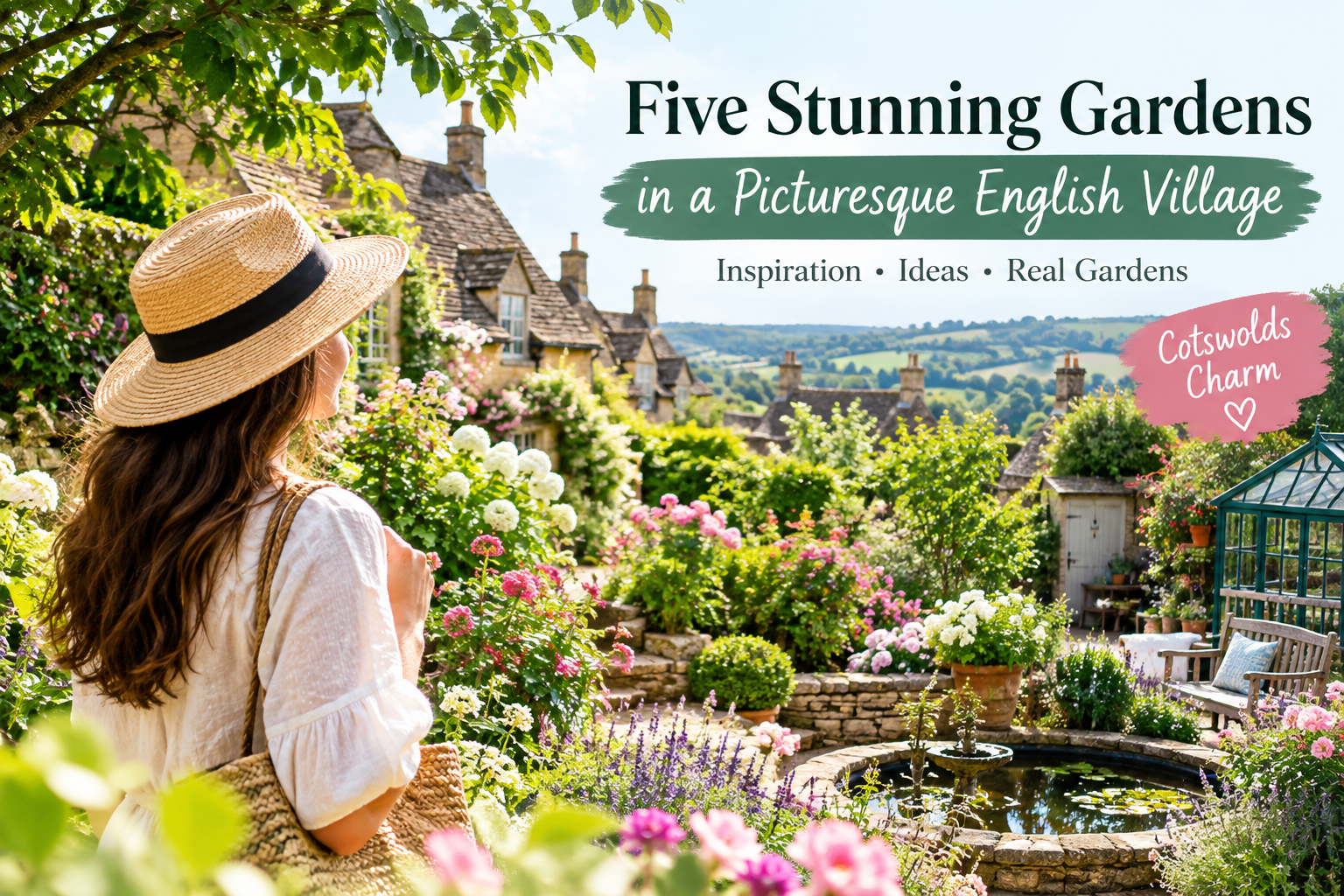
Welcome, I’ve just visited five stunning gardens in a picturesque country village in England, and there’s lots of ideas for your own gardens. It’s Alexandra here from the Middle-Sized Garden YouTube channel and blog, and I’m often asked for my recommendations when visiting gardens, and one of the first things I say is go to the NGS, the National Garden Scheme, and find a garden near you.
Private Gardens You Can Actually Relate To
There are some, you know, big famous gardens in the NGS, but most of it is private gardens, and of course private gardens are the ones that you will be able to relate to most, and one of the things they’ve been doing is building up their group open gardens, so what I went to see was five of the gardens in a group open gardens in a village called Stanton.
Stanton — A Picture Postcard Cotswolds Village
Stanton is in the Cotswolds in Oxfordshire and it’s absolutely picture postcard beautiful. Of course all the traditional things like the dairy and the forge and the post office and the shop are now homes, but the conversion has been very sensitive and it is still the very idea of what anyone might think an English country village would be.
Starting With the Smallest Garden in the Group
Because the Cotswolds are hills, all the gardens are sloping in one way or another, so I’m going to start with the smallest of the gardens. In the country you generally expect gardens to be bigger than in town, but Elaine and Kevin’s garden is actually really quite a small garden for a country garden, but it is beautiful.
A Small Garden Done So Perfectly
General Vibe & Layout
Slopes Down
- Descends
- Gradually drops
- Falls downward
- Slants downward
- Dips lower
- Runs downhill
- Gently descends
- Drops away
- Slopes downward
- Falls off
Perfect
- Ideal
- Impeccable
- Flawless
- Exceptional
- Outstanding
- Superb
- Magnificent
- Wonderful
- Sublime
- Picture-perfect
Central Path
- Main walkway
- Central walkway
- Primary pathway
- Main pathway
- Central route
- Principal path
- Main axis
- Central axis
- Primary axis
- Main passage
- Core walkway
- Principal route
Upper & Lower Areas
- Seating terrace: Patio, paved area, outdoor seating zone, courtyard.
- Arch: Arched trellis, garden archway, pergola, gateway.
- Bottom of the garden: Far end, lower tier, rear boundary, foot of the garden.
Water & Rest Features
- Fountain: Water feature, water jet, bubbling spring.
Pond
Pool, water feature, water garden, small basin, ornamental pool, garden pool, water basin, decorative pool, reflecting pool, garden water feature.
Bench
Seat, garden seat, resting place, outdoor seat, seating area, garden chair, park seat, wooden seat, resting bench, outdoor bench.
Hidden Back Section
Concealed
- Concealed
- Unseen
- Unnoticed
- Secret
- Private
- Enclosed
- Shielded
- Protected
- Screened off
- Covered up
- Shrouded
- Unexposed
- Isolated
- Remote
- Sequestered
- Sheltered
- Discreet
- Inaccessible
- Away from view
- Kept from sight
Greenhouse
- Greenhouse
- Glasshouse
- Hothouse
- Conservatory
- Plant house
- Garden greenhouse
- Growing house
- Propagation house
- Nursery greenhouse
- Glass conservatory
- Garden conservatory
- Plant conservatory
- Cultivation house
- Protected growing area
- Indoor growing space
Potting Shed
Garden shed, gardening shed, potting house, garden workspace, gardening workshop, tool shed, toolhouse, plant shed, garden workshop.
How Kevin and Elaine Manage Their Colours
I also love the way Kevin and Elaine manage their colours, there’s lots of green and white but they’ve also got clumps of pink and blue, really pretty clumps where they’re planting together quite similar shades of different plants, and that I think is really effective.
A Smart Way to Deal With Established Trees
When Elaine and Kevin moved in there were several established trees in the garden, but they removed most of the lower branches so that they could create light and space for planting, which is of course a very good option rather than removing trees altogether.
Liz Philpott’s Large Garden Sloping to the Countryside
Slopes Upward Away From the House
- Rises gently from the house
- Ascends away from the house
- Gradually climbs toward the countryside
- Rises toward the open countryside
- Inclines away from the house
- Gently rises beyond the house
- Elevates toward the surrounding countryside
- Climbs gradually toward the rural landscape
Center of the Village
- Heart of the village
- Village center
- Middle of the village
- Central part of the village
- Village core
- Central area of the village
- Main part of the village
- Hub of the village
Large Garden
- Spacious garden
- Expansive garden
- Extensive garden
- Generous garden
- Large outdoor space
- Broad garden area
- Substantial garden
- Sizeable garden
- Vast garden
- Roomy garden
Very Expensive
- Extremely costly
- Highly priced
- Exceptionally expensive
- Premium-priced
- Cost-prohibitive
- Pricey
- Expensive
- High-cost
- Costly to maintain
- A major financial investment
Terracing
- Tiered landscaping
- Stepped landscaping
- Layered garden levels
- Raised garden levels
- Terraced levels
- Tiered planting areas
- Stepped garden beds
- Raised platforms
- Leveled garden sections
- Multi-level landscaping
- Halfway up: midway, in the middle, central section.
- Swoop and dive: dip and dart, fly fast, zoom around.
There’s a stream running down this garden and their predecessors put a pond in halfway up. Liz has used the slope very effectively for planting, obviously when you’re planting a large garden it can be very expensive and she said that after renovating the house there wasn’t much budget left, so she’s had to go with plants that she can get easily, grow herself from seed or propagate.
Using Big Clumps of Plants to Fill a Large Space
So she’s used really large clumps of groups of plants to create splashes of colour around the garden, and I think that’s a really effective way of making the most of quite a big space. This border is essentially a raised bed although obviously the raising is the slope of the garden, she’s got Geranium macrorrhizum and several other things, and I’ll just take you round through this border with just a little bird song in the background to show you what it’s like.
Seating Areas That Let You Enjoy Every Corner
Another thing that a large garden needs is seating areas so that you can look at different parts of the garden, and as well as near the house and halfway up the garden they’ve also got a little bench that looks over the garden to the side, and then in one corner they’ve got a wilder seating area.
Ancient Apple Trees and a Long Grass Area
Although most of the lawns are well maintained and quite short, they’ve also got a long grass area beside two ancient apple trees and some vintage rocking chairs, and once again look at the trees, these are very, very old apple trees and they’re gathering moss and lichen, but the moss and lichen isn’t going to kill them and it gives a lovely texture.
What to Look for in the Hard Landscaping
Another thing to check out when you’re visiting gardens is how they’ve managed the hard landscaping. Liz achieved her lifelong ambition to get a greenhouse, and so the paths around the greenhouse are made with the leftover greenhouse bricks, and that’s not just an economy, it just makes it look much more harmonious, and similarly the pavers on the terraces are made of a Cotswold stone that’s very close to the Cotswold stone of the house.
Jackie Jones-Parry’s Former Farmhouse and Its Old Pond
Jackie Jones-Parry’s house is a former farmhouse and in the old days farmhouses always had a big pond next to them where the livestock could drink and it could be used as a source of water for all the farm activities, and about half of Jackie’s garden is taken up with what must have been the old farm pond, and this means that trees are also a really big part of Jackie’s garden.
Think About Contrasting Your Trees, Not Just Your Foliage
And what I think we can take from this is, you know, when you’re planning a border quite often you will be advised to think about foliage contrast, but it’s much rarer that people remind you to think about contrasting your trees. Here there’s a fantastic weeping willow which is very good for soaking up extra water, and it contrasts with a nice sharp shape of a conifer of trees that have been beautifully sculptured and are quite geometric.
Mixing Wild Trees With Geometric Shapes
And then other trees that are much more relaxed and wild, such as the variegated sycamore. It’s just a beautiful peaceful site and it’s done by contrasting the foliage and the shapes of trees. What is important to remember is of course you have to maintain trees properly and that can be expensive, although you usually only have to do it about once every three to five years.
Climbers Up the House — Are They a Good Idea?
Another thing I think we can take from Jackie’s garden is the use of climbers up the house. It used to be that in the UK most houses had climbers up them, it was just normal, but over the past few decades builders and decorators have very much advised against it.
Choosing the Right Climbers for Your Brickwork
It is very difficult for them to work around climbers, and also there are some climbers that can cause damage to brickwork, particularly if the brickwork is not in good condition. You would need to research climbers quite carefully to make sure you got the right ones if you want climbers up your house, but most of them are not damaging. Jackie has got Virginia creeper, hydrangea and grapevine.
Jenny’s Garden — Formal Parterre Meets Gentle Slope
Jenny’s garden was originally designed by her predecessors and what they have left is a very formal parterre area with an urn in it. Jenny’s garden slopes sideways rather than up and down, and it’s quite a gentle slope, so on the whole it hasn’t had too much impact on the garden.
From Formal Parterre to a Wild Corner Wildlife Patch
The parterre is cut into it, but up towards the side she’s got some what could almost be called raised beds, but it’s actually making the most of the slope, plus some arches and a path along that, and round the corner from the formal area she’s created a wildlife patch with piles of logs and an old roller and plants that just self-seed themselves, so there’s a lovely contrast here between very formal and very wild.
Jacqui Tucker’s Garden — Structure, Planting and Wildness
And Jacqui Tucker’s garden is also a wonderful balance between structure, good planting and a certain amount of wildness. Once again, garden visitors should pause to admire the trees. Right in the center of the lawn, Jacqui has got an ancient sycamore, it’s really quite old, and many people would have been tempted to cut it down and make the lawn more open.
Why You Should Never Cut Down an Old Tree
But actually a very old tree offers huge benefits to the garden. It gives it a sense of age, of distinction, it adds vertical interest, this tree frames both the building and the garden. Elegant & Artistic
- An exquisite statue framed by naturalistic foliage
- A stunning artwork nestled in overgrown greenery
- A graceful carving embraced by uncultivated flora
- A fine piece of art ringed by rustic vegetation
Natural & Rustic
- A lovely monument set amidst untamed landscaping
- A charming art piece encircled by free-form growth
- A scenic installation bordered by organic greenery
- A picturesque figure couched in rugged wilderness
And once again this is a garden with short mown lawns but a certain amount of contrast. She’s got a beautiful sculpture in one corner, and around it is a wild, semi-wild planting. She’s planted a rose and some other things, but she’s also allowed things like plantains to soften the planting and it looks so pretty.
Self-Seeders That Just Chose to Be There
Over by her log store, things like Linaria Canon Went have just popped up, they chose to be there, they’re not self-seeded from her garden, she doesn’t know where they came from, but they just add a little something. And she does also have some very unusual plants in the corner of the garden, she’s grown a massive Paul’s Himalayan Musk right up to the top of a tree, and this is beautifully fragrant, so this is another thing you can use trees for, to show off climbers.
The Tortoise Garden — Something You’ve Never Seen Before
And then if you go beyond the Paul’s Himalayan Musk you will find something that I really don’t think you’ve probably seen before, and that’s a tortoise garden. Jacqui has tortoises and so she’s created a little gated area where there’s planting for food and shelter, and they’re so happy there that they actually laid six eggs which she managed to hatch in an incubator, and all six survived.
How Trees Make All the Difference in a Garden
You can find which gardens are open by going to NGS find a garden, and one of the things you’ll have noticed is that I’ve talked a lot about how important trees are in creating the atmosphere in a garden, so don’t miss this next video and what you need to know before you call in a tree surgeon or charge up your chainsaw, because actually how you treat your trees will make a huge difference to their impact. And thank you for watching, goodbye.