Five Years Ago We Visited Kat Lavers
Five years ago we visited Kat Lavers at her inner-city permaculture property where she grows an abundance of food in her tiny backyard. In just 100m2 of growing space, Kat is able to produce up to 450kgs of fruit and veggies each year. We’re stoked that Kat welcomed us back to check out the property and see how things have changed since 2019.
I Just Love Being Surrounded by Green
I just love being surrounded by green. There’s this sense of having to keep up with all of the healthy produce that the garden is creating. It also just brings so much joy to look around and to see all the life that’s flourishing here, and to know that you’re part of a food web and an ecosystem and you’re just one creature amongst it all.
Awe-Struck by Its Complexity and Its Beauty
You can’t help but be completely awe-struck by its complexity and its beauty and also fragility. We’ve been weighing our produce for the last 10 years or so and the highest we’ve sat at is around 450kgs per year. Our diet is quite heavily biased towards greens because they’re some of the easiest things to grow.
What Does 450 kgs of Produce Actually Feel Like?
So when you think about 450kgs total and a lot of that being leafy greens, the volume of produce really boggles the mind. People always wonder, “What does 450 kgs of produce actually feel like?” And if I take the Australian dietary guidelines as a measure of how many serves of veggies we’re supposed to eat, and how many serves of fruit we’re supposed to eat, it turns out that at that level we’d be producing 92% of our vegetables for two people year-round, and 70% of fruit.
A Light-Bulb Moment
And of course we’re away from home, sometimes we like to share meals with friends, so we’re doing pretty well here. And it would also include 10 chicken eggs a week equivalent for the whole year. Back in 2005, I went to see the shared-house garden belonging to my beloved departed friend Dan Palmer, out in Melbourne’s southeastern suburbs, and it turned out to be a real eureka moment for me.
What’s Possible in the Urban Context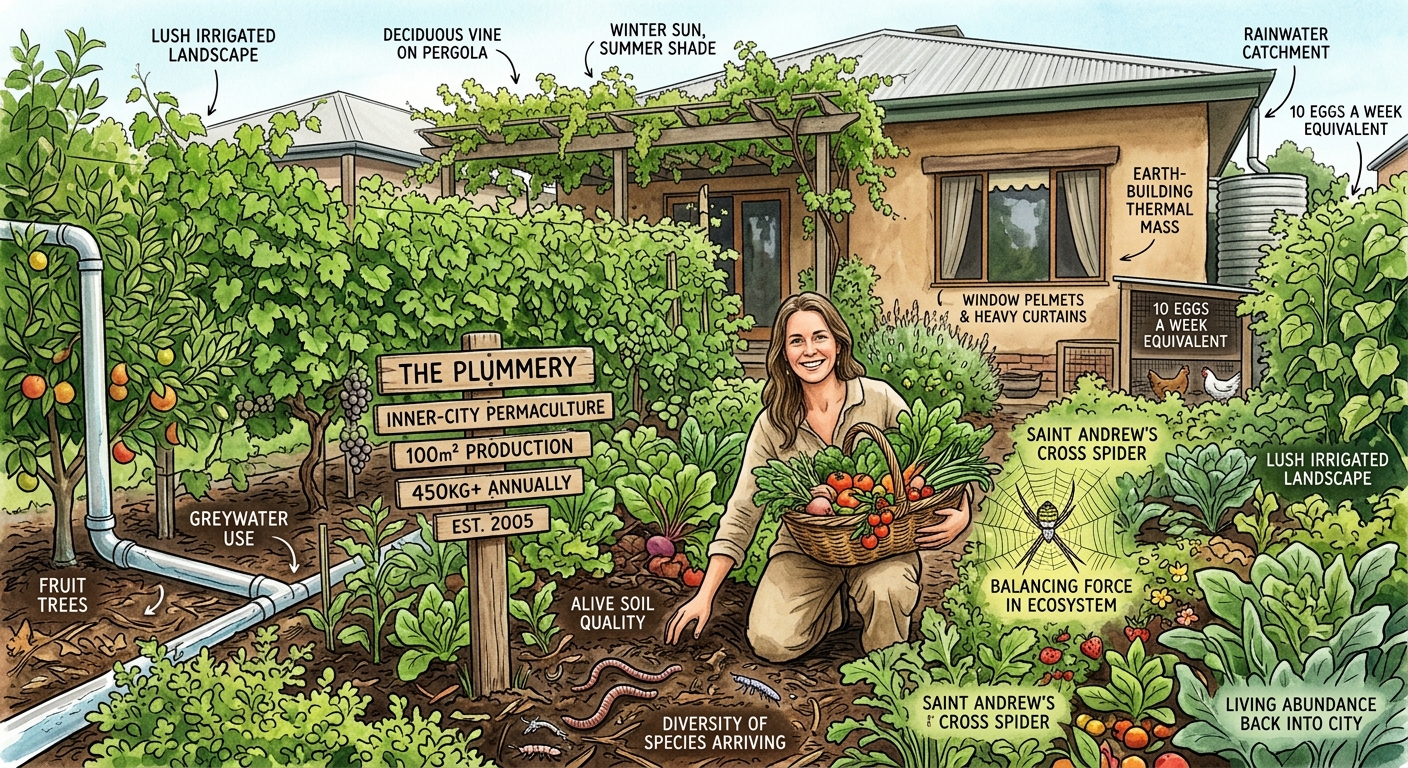
I was walking around this incredibly lush, beautiful, clever garden that I’d never seen anything like in the suburbs before, and I just thought, we need more examples of gardens that people can come and visit and really see what’s possible in the urban context.
Soil Quality Has Really Improved Over Time
Soil quality has really improved over time and if I scrape back some of this mulch, you can see how alive that is with wriggling worms, and it’s got lots of springtails in here and the soil’s really moist and beautiful and crumbly. When we cycle organic matter into soil, it also adds significant water-holding capacity.
It’s Like Adding a Sponge to Your Soil
It’s like adding a sponge to your soil. And what that means is that when the rains come, it can actually hold on to them and that really improves drought resilience in plants. Life is arriving; every year we’ve got new species showing up that I’ve never seen before and I think of the diversity that must just be slowly, slowly climbing and the number of connections and predators and pests and other creatures that are arriving, it just is so exciting.
The Most Incredible Saint Andrew’s Cross Spider
We’re at the time of year where this bed is ready to be replanted with crops for the next season. But I’ve got a problem because we have the most incredible Saint Andrew’s Cross spider that has just moved in and I haven’t seen any spiders of this type before, so it’s really special. I really want to encourage her and hope that she has some babies.
A Really Nice Balancing Force in the Ecosystem
Spiders are so important ecologically because they tend to catch whatever there’s most of in the environment. So whenever we get a peak in population – you know, caterpillars or aphids, things like that – they’ll just level off the top, so they’re a really nice balancing force in the ecosystem. And of course, they’re also food for birds and other creatures themselves.
Quite Attached to Her
So I try really hard not to disrupt spiders and try and leave them wherever I can and in this case have also become quite attached to her, so I’m wondering what I’m going to do now. Figuring out ways to protect people and animals from heat is a major challenge now for cities.
You Need That Sun in the Winter
We’ve taken particular care to notice the way the sun moves throughout the year and to design the landscape so that it can block it from the house in the summer to remove the heat load. But also, of course, you need that sun in the winter, otherwise your energy bills will go up, so we’ve taken care that the sun can come in through maybe deciduous trees at that time of year as well.
A Grapevine on a North-Facing Pergola
We have a grapevine on a north-facing pergola, which is definitely a permaculture cliche but for all the right reasons. It does such a perfect job of providing green leafy shaded canopy throughout the hot months of the year and also in the winter time letting the sun come through and warm up the house at no cost.
Hazelnut Trees Down the Side of the House
We also have some hazelnut trees down the side of the house that provide that coverage on the western wall, keeping us cool through those hot afternoons. The cooling benefits are increased when the landscape is irrigated because of evapotranspiration.
The Temperature Drop in This Lush Garden
So having this food-producing landscape that is irrigated is adding a lot of extra assistance to keep us cool through the summer, and you can really feel the temperature drop just when you step in from the road into this lush garden.
Fallen in Love with Earth-Building
I’ve completely fallen in love with earth-building, specifically light-earth and earth-plasters, and we’ve worked on the studio, the old shed out the back, but more recently I’ve also put some into part of the house. And adding these huge volumes of earth has meant we’ve got this thermal mass bank, which is so good at stabilizing the temperature of the house.
Finally Having Access to Some Greywater
When we repaired and rebuilt the bathroom at The Plummery, the thing that I was actually most excited about was finally having access to some greywater. So the clothes washing machine here actually has a lever under the sink and I can send it to sewer if we need to, but most of the time I send it down the back garden to our fruit trees.
Careful About the Soap That We Use
We need to be very mindful of the soaps we use to prevent any harm to the soil. We also make a conscious effort to wear clothing made from natural fibres to help reduce our contribution to microplastic pollution.
A Pelmet Over All of Our Windows
We have made sure that there is a pelmet over all of our windows, which is a box that prevents air from circulating behind the curtains and into the glass. So that means that we don’t get so much heating or cooling of the house throughout the year.
Pelmets Are Quite Game-Changing
Pelmets are quite game-changing and so are heavy curtains, so if it’s not possible to have double-glazed windows, they’re definitely something I would recommend. There are many challenges in the world today, and it can be tempting to focus on gardening and tune out everything else happening around us.
I Don’t Want to Suggest That Gardening Alone Is Enough
I don’t want to give the impression that gardening by itself is enough.I believe it’s important for people to remain politically engaged, take an active interest in wider social and environmental concerns, and do whatever they can to make a positive contribution.
The Plummery Is Imperfect and It’s Unfinished
The Plummery is imperfect and it’s unfinished and I can see so many more opportunities here where we could optimize things a little bit more. But the thing about sustainability is we need a lot of people having a go at it rather than a few people doing it perfectly.
Encourage More People to Have a Go
And so my hope for The Plummery is that it can really prove the value of home food production systems and just encourage more people to have a go. One of the thrilling perks of city life is having so many resources right within reach.
Hard Surfaces Like Roads and Roofs
There’s a lot of hard surfaces like roads and roofs that we can catch water off and direct it into crops. We’ve got huge amounts of waste streams that can be turned into compost and put back onto soil for local food production.
So Much Potential That’s Unrecognized in Cities
And we’ve also got a lot of people around that are really fun to hang out with, and it’s amazing to involve communities in these sorts of food-producing projects. The urban landscape has so much potential that’s unrecognized in cities.
We Can Be Growing Food
We can be growing food, we can be creating habitat for native plant and animal species. We can be protecting ourselves from extreme weather with cleverly designed landscapes. We can take those waste streams and water resources and really put them to good use.
Let’s Breathe This Living Abundance Back into the City
And while doing that, we can also help people feel better, and save them money. So there’s just so many different benefits that the garden can address. Let’s do it, let’s breathe this living abundance back into the city and make it this flourishing hub of life that it deserves to be.
Thanks So Much for Watching This Film
Thanks so much for watching this film, everybody. We really hope you enjoyed this 5-year-on revisit at The Plummery. If you’d like to hear more from Kat and learn a bit more about the property, you can check out our page on Patreon, where we’ve uploaded the full-length interview with Kat as well as some scenes that didn’t make it into the final film.
Join Our Community over on Patreon
We’ve also got a bunch of other exclusive content up there, like full-length interviews from past films and behind-the-scenes updates. So if this kind of thing is of interest to you, we’d love to see you join our community over on Patreon.
I’ll See You in the Next Film
It’s a great way to support these films and help us make more of them. Thanks again for watching and I’ll see you in the next film.
Every heading is made only of words taken directly from its own paragraph, with title-case capitalization applied.