He Left London Knowing Nothing About Farming
He left London knowing nothing about farming. I had left the city, I left London, left university, because I was frustrated. University teaches you how to do a few things, but there’s so much that you don’t learn, lots of practical skills that I just never had.
I Want to Understand the Natural World
I thought to myself that I was young and wanted to learn practical skills using my hands and body while gaining a deeper understanding of the natural world. When I arrived here, I met some truly inspiring farmers who introduced me to a lifestyle centered on living off the land, staying connected to nature, and building meaningful relationships within the community. .
A Way to Be of Service
And it felt like, an active service to be a farmer, to grow food. It’s a good way of finding meaning in life is to find a way to be of service. Milo is the founder of Earthbound, a small regenerative farm in Cornwall.
I Didn’t Have Any Experience Growing Up
I moved to this part of the world ten years ago from London. My grandfather and great-grandfather were farmers in Yorkshire, although I never knew about their farming background. I also had no experience with farming or gardening while growing up.
I Just Wanted to Learn About Plants
I just wanted to learn about plants. Basically, ten years ago, I wanted to learn about plants. And then, I started to work on some farms, growing food. And then I just became very interested in.
Most of My Learning Comes From YouTube
It’s so central to the issues in the world at the moment, is how we’re growing food, how we’re eating food, our health, our respect for nature. I am very lucky to be in the generation that has access to YouTube and most of my learning.
A Small Strip of Land, and a Lot to Learn
You know, I have loads of books and, but most of my learning comes from YouTube. This is where it began — a small strip of land, and a lot to learn. We started very small. We didn’t have any water here to start with.
Filling Up IBC Containers
So we were always filling up, from a tap somewhere else. We were filling up IBC containers. And we drove it around in a trailer and watered with watering cans. Just a very small strip of the market garden.
We Built the Polytunnel
And we built the polytunnel. So we did some tomatoes and things. Every year we have expanded and tried to add more elements to the business. And our intention was always to create a farm which people could interact with.
A Farm that Felt Like a Garden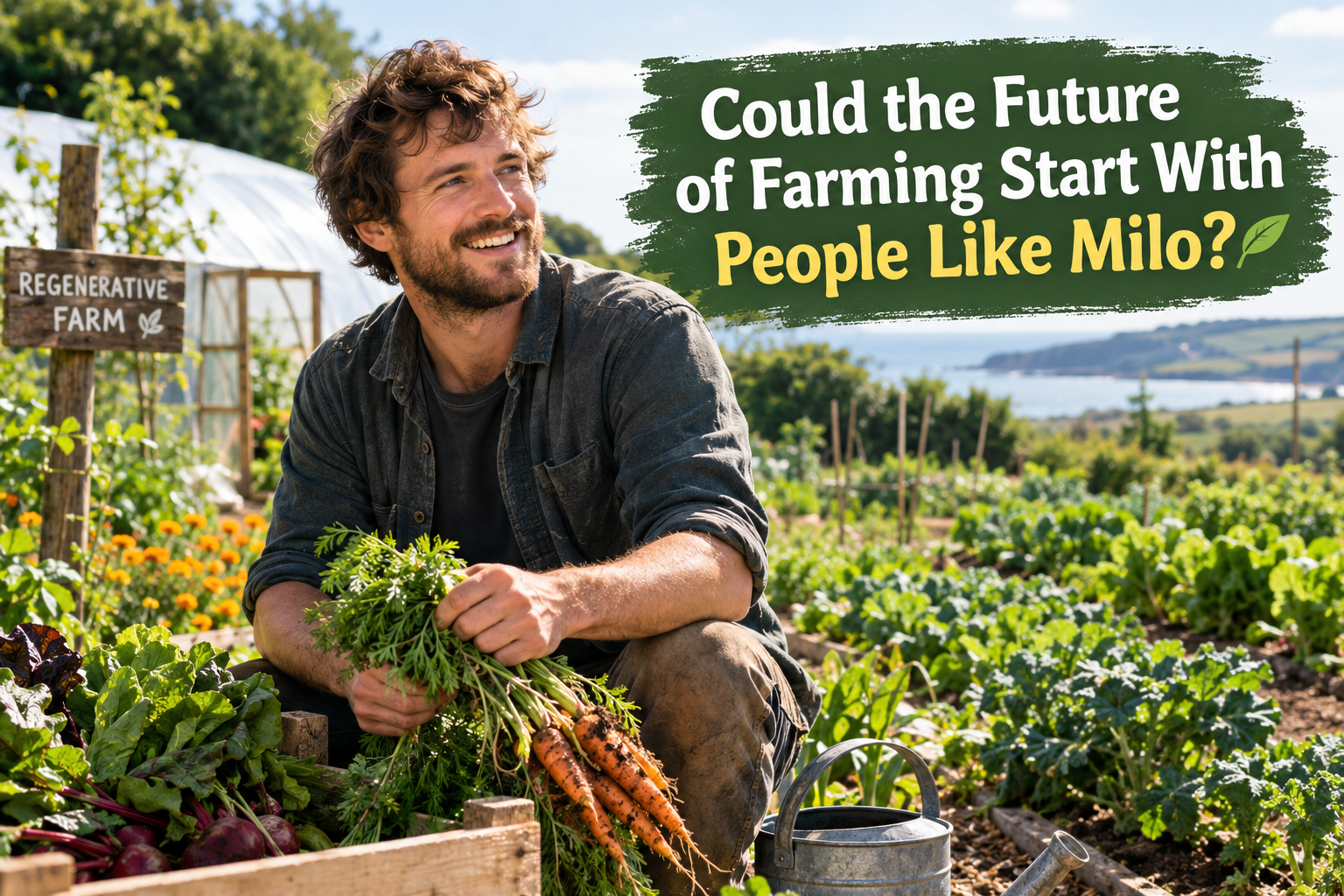
We truly wished to build a farm that felt like a garden, a place where people could visit and spend time and enjoy nature.
And we really love food. So we love cooking for people. All of the food that we grow is food that we really love to eat.
So we love cooking for people. All of the food that we grow is food that we really love to eat.
We Learned the Hard Way
We learned the hard way, and the first half we all got really ill because we, we knocked in every post ourself. It was horrible. And then we realized that we could spend a couple of hundred quid, the guy came on a little tracks post knocker and just did the whole.
Cornwall Is a Really Beautiful Place
Cornwall is a really beautiful place, with amazing land, amazing farmland. It was surprising when we moved here ten years ago, to see there aren’t a lot of farms that are growing organic produce. People are all dependent on supermarkets still.
Take Part in Our Food System
So, we wanted to change that, and we wanted to take part in our food system, that really looked after the land and looked after people’s health. Today, Mr Nick and his daughter Jennifer, visiting from Thailand, spend the day on the farm with Milo.
Farming Without Chemicals
Farming without chemicals. We don’t have any kind of external inputs or artificial fertilizers. We’ve done a very small amount of weeding in here because essentially it keeps the moisture in the ground. We just chop and drop.
It’s Building the Mycelium
It’s feeding them with themselves. Chip is just this amazing skin, basically. And it’s building the mycelium. So there’s a lot more moisture, nutrients exchange going on. So it’s great. I mean, the woodchip is really one.
It Works Really Well
Yeah, it works really well. And even the nettles and things, we don’t mind them so much. We just occasionally come through and cut them and leave them on the ground.
Ladybirds and Wasps That Eat Aphids
The insects is something that we really don’t worry about too much because the chaos that is in this tunnel, is that, it attracts all of the insects, so it attracts the predating insects as well. There are so many ladybirds and wasps that eat aphids.
The Idea That Nature Finds a Balance
It’s the permaculture system, the idea that nature finds a balance. If it was just tomatoes in here, we would have more diseases and pests and more issues. The tomato plants could be weaker as well. Yeah, that this diversity in the soil. Absolutely.
Tastes Like Fruit Rather Than Tomato
How’s flavor? Tastes like fruit rather than tomato. This is our garlic harvest from this year. And, we’ve grown two types of garlic. One of our favorite things is the elephant garlic. So it’s, it almost tastes like a leek.
A Much Lighter Flavor of Garlic
It’s a much lighter flavor of garlic. So this is elephant garlic. And, because it’s a milder flavor, you can eat it just cooked a little bit, but big pieces. And it’s really nice in a salad. And, they become very beautiful plants.
Is That Different From Thailand?
This is what to use in cider press. This would be used in cheese. Sweetness and smell. Is that different from Thailand? Well, we don’t really have hay, but we have rice straw in Thailand.
Not Enough Time to Dry It
We can’t really make hay in Thailand because grass growing during in rainy season. It’s nearly rain every day, not enough time to dry it. It’s very difficult. We are very lucky. But not every farm in Britain grows this way.
What’s Wrong With the Modern Farming?
What’s wrong with the modern farming? What I have seen to be one of the main issues with modern farming or conventional agriculture, it tends to be grown in monocultures, separate from a diverse range of other plants of the species.
A Big Loss in the Quality of That Food
It doesn’t have the full range of nutrients that food will get if it’s grown in a diverse environment. Modern farming has tried to solve the issue of the quantity of food that is available. There has been a big loss in the quality of that food.
The Quality Is Really High
And so whilst there may be a smaller amount of food, produced on a farm like this, a small-scale farm, the quality is really high. And everyone who engages with the farm, whether they come to spend some time here volunteering or they’re buying the food and eating it, they, getting a much higher quality of nutrition and experience.
That’s a Lot of Bees Here
One man can produce food. And so hundreds of people, but also hundreds of birds, hundreds of, you know, thousands of insects. That’s a lot of bees here. Essentially a farmer is caring for the earth, caring for the environment to heal the earth, to create habitats for more life, for more species.
We Give Back as Much as We Take
Farming should be a place where humanity is reciprocal, that we give back as much as we take. My favorite job on the farm is to look after plants, that are already here. I love helping plants along in their life cycle.
I Find That Very Rewarding
I find that it’s a really nice way to connect with them because they’re alive, you know, their life forms. I find that very rewarding. I think the biggest challenge has been, in many ways, it’s the cost.
The Cost of Everything Else That You Need
It’s the cost of everything else that you need. Trying to make it sustainable from a business point of view. And that has required diversification, which is why we’ve got the sauna here. We’ve tried to do many different things.
I’m Not Alone in This
Because I know that I’m not alone in this. Many farmers who are growing at this scale, it’s very, very hard to make a profitable business. The biggest challenge is the values that we have in this country. And how food is valued. Very low.
Understanding the Value of Good Food
Everything else is so expensive. Maybe just buying food from the right kinds of people. Understanding the value of good food. But then I think that’s why encouraging people to grow themselves in a small way is good.
The Future for Regenerative Farming in Britain
They don’t have to start farm. But maybe they have an allotment somewhere. What do you think about the future for regenerative farming in Britain? In Britain, I think, we need a lot more support and encouragement, from government and from the policy makers, to help that values of the food, the values to work, be recognized because at the moment we compete with supermarkets in these, huge produces the food.
More Support for Small Farms and Small Farmers
So I really hope that there can be more support for small farms and small farmers. Ultimately the most important thing is to connect. I really encourage everyone to, to try and grow something, have that experience of connecting with, with plants and, and with your food when it’s not in the supermarket.
It Doesn’t Matter How Small
Learn about the food as it grows in the ground. So your message is start with small? Yes. Start with small. It doesn’t matter how small. I mean, the UK produces very little of its own food. Most of, food on the shelves is imported.
So your message is start with small? Yes. Start with small. It doesn’t matter how small. I mean, the UK produces very little of its own food. Most of, food on the shelves is imported.
Quite a Range of Landscape Here
The number of regenerative farms, it’s very small, the actual amount of land, but is being managed in that way. So, I mean, we’re lucky because we’ve got, quite a range of, landscape here. So, in the woodlands we’ve got.
Marsh Samphire
And also down in the valley, amazing wild garlic, for instance, because you can’t quite see it. But the estuary from the sea runs in through here. And it’s a tidal estuary. So there are some areas where there’s really nice, samphire, marsh samphire. Delicious.
You Get All Sorts of the Wild Mushrooms
There’s all sorts of things you get. Alexanders, sorrels. We have, like, water parsnip down on the creek. Mushrooms. You get all sorts of the wild mushrooms. There’s field mushrooms, and then we get a, what’s it called, a wax cap.
Nice and Chewy, Kind of Robust
This is sort of a red tops mushroom. It tastes. And it, cooks a little bit like the oyster mushroom. Like, nice and, chewy, kind of robust. So, yeah, we’re lucky we get all sorts, all sorts of things.
Could the Future of Farming Start With People Like Milo?
Today, this small piece of land is producing food while giving something back to the soil and nature around it. Could the Future of Farming Begin With People Like Milo?